
 ع
ع


Mr. Fitwi Woldegergis, Director of the Students’ Summer Work Program, indicated that this year’s campaign will run from July 6 to August 15 in five regions and will engage more than 30,000 students, 37 percent of them female. The director added that around 1,000 teachers, agricultural experts, barefoot doctors and coordinators drawn from 160 centers will oversee the effort. According to the Ministry of Information, Eritrea, which released the details, the initiative marks the 28th consecutive year of the program.
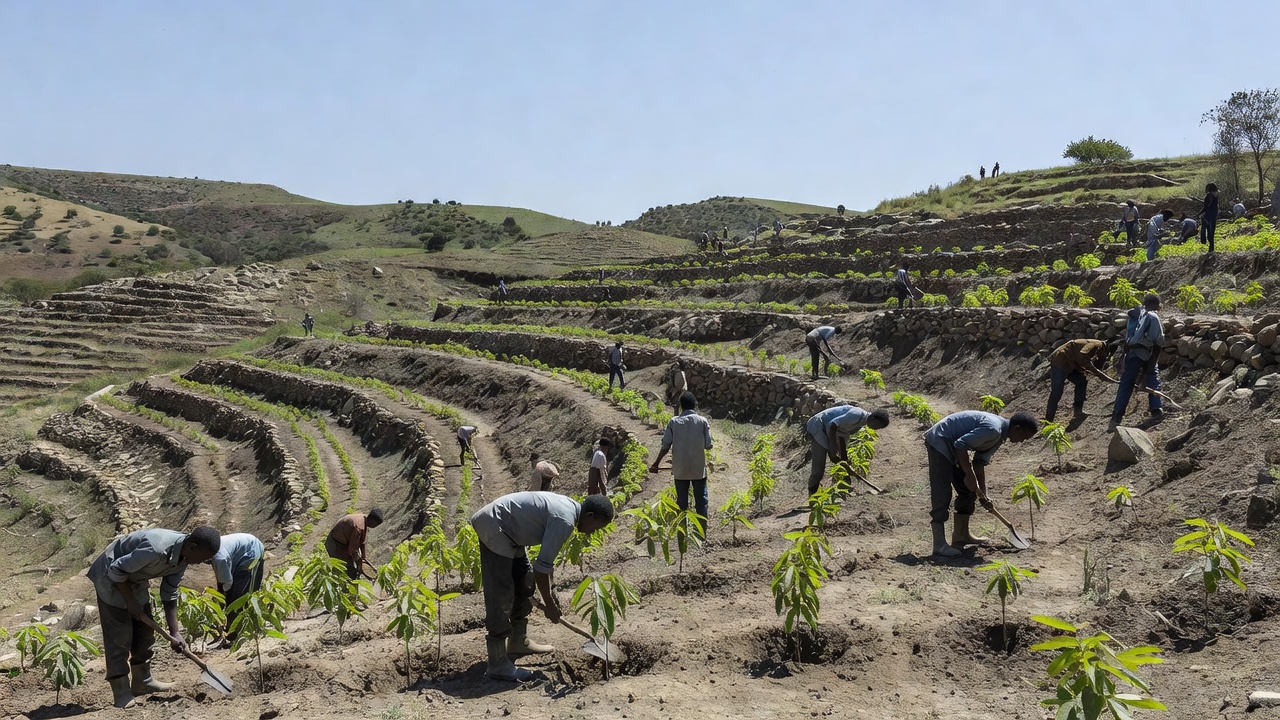
Ninety-seven percent of participants will concentrate on water and soil conservation together with afforestation projects while the remainder will handle environmental sanitation, documentation tasks, traffic safety initiatives, dirt road renovations and the construction of school compounds. The announcement from the ministry further outlined that more than 1.4 million tree seedlings are scheduled for planting during the campaign. Construction and renovation of terraces as well as water catchment schemes will form additional core elements of the work.
Students based in Asmara, Keren, Mendefera and Barentu will join dedicated traffic safety programs as part of their contribution. Due to local climatic conditions the program in the Southern Red Sea Region began ahead of schedule on June 8 with roughly 600 students already involved. The ministry noted that the main phase aligns with favorable weather across the other regions to maximize participation and output.
The Students’ Summer Work Program first commenced in 1994 and has maintained a consistent focus on environmental rehabilitation since then, according to the Ministry of Information. A 2017 review of the campaign’s initial 22 years reported that the program had overseen the digging of 19 million holes, the planting of 23 million seedlings and the building of 17,000 kilometers of terraces between 1994 and 2016. Eritrean government communications have positioned these cumulative efforts within wider national drives to combat desertification and support regional initiatives such as the Great Green Wall.
Participation has historically emphasized youth engagement in practical national service while building awareness of environmental stewardship. The current edition continues that tradition with a substantial female student component and specialized expertise provided by agricultural and medical personnel. Coordinators at the 160 centers will manage logistics to ensure activities proceed efficiently until the scheduled close on August 15.
Earlier editions have produced measurable gains in vegetation cover and soil stability in targeted areas, the ministry’s historical summary indicated. This year’s projected outputs of seedlings, terraces and catchment structures are expected to add to those longstanding results. The program remains a central feature of Eritrea’s annual youth mobilization calendar.