
 ع
ع

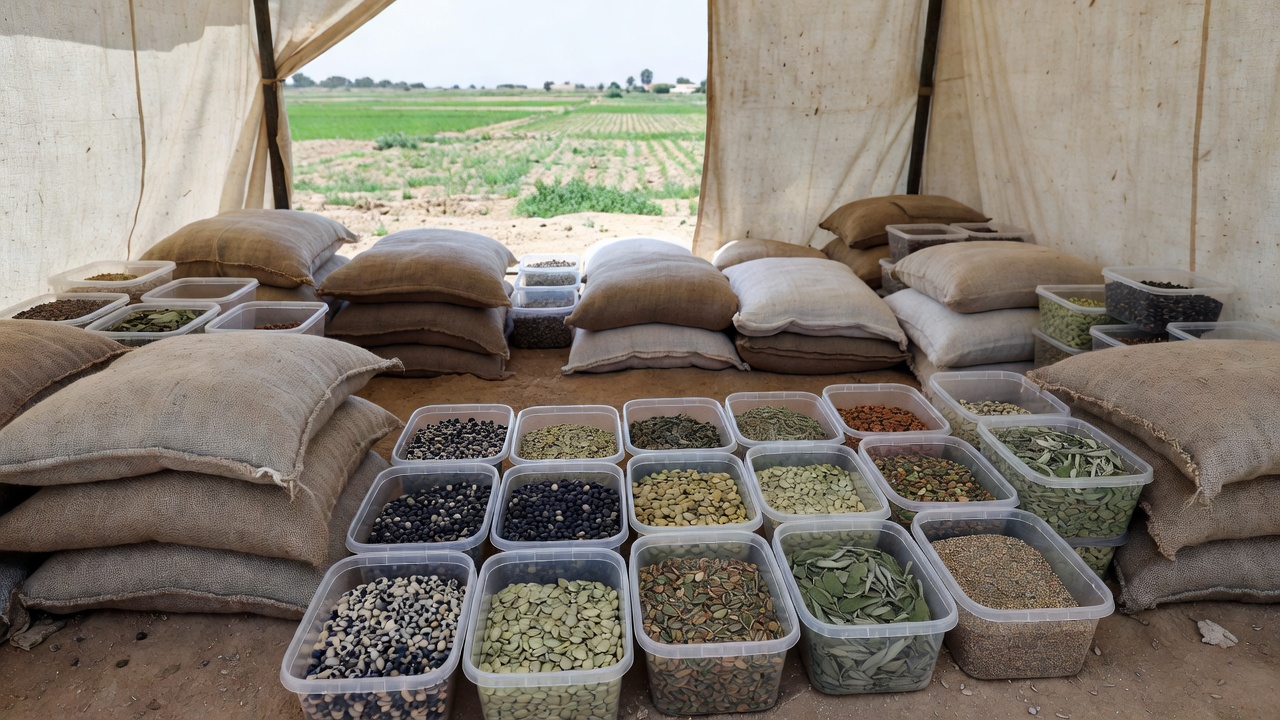

A seed bank in central Gaza is helping local farmers maintain indigenous crop varieties despite the severe limitations on arable land resulting from two years of conflict. Reuters reported on Wednesday that the facility known as the Bank of Seeds was originally destroyed in the town of Qarara in early 2024. Its owner Salama Muhanna has since worked with other farmers to reconstitute stocks using contributions from previous participants in the project. The seeds are now housed in a makeshift tent in Deir al-Balah where they are stored in simple burlap sacks and plastic containers.
Before the war the bank maintained 70 tons of seeds across 42 crop types that included staples of Palestinian agriculture such as black-eyed peas, watermelon and sage. “We had refrigerators, solar power, a dryer, a seed-cleaning and sorting machine – we had everything,” Muhanna told Reuters. The 71-year-old said he and his team have assembled a more modest collection of 32 local seeds in the months since the destruction. This effort forms part of a wider attempt to keep traditional farming practices alive in the enclave.
Most of Gaza’s pre-war farmland is located in areas that are currently under Israeli military control and therefore off-limits to Palestinian cultivators, the Reuters report indicated. The enclave’s entire population of approximately two million people has been confined to around 30 percent of its territory, large parts of which have been laid waste by bombardment. A recent analysis by the UN Food and Agriculture Organization and the UN Satellite Centre found that only three percent of the enclave’s cropland remains usable, the UN News service reported in August.
The seed bank operates by providing seeds to trusted farmers who are expected to return a portion of their harvest for future distribution, according to documentation from the Gaza Urban and Periurban Agriculture Platform. Prior to the war the project supported as many as 250 farming families but that number has declined to 78 as displacement and infrastructure damage have taken their toll. The platform’s report on the bank’s revival highlighted partnerships with landowners to grow out seed stocks using limited available resources including labour from 10 workers.
Muhanna has emphasised the reliability of these local varieties which can consistently deliver 80 to 90 percent of the same yield each year. This consistency has made them a vital resource for farmers struggling with restricted access to imported seeds and inputs during the conflict. Additional support from organisations such as the International Committee of the Red Cross had helped launch the original bank in 2017, a background detail noted in multiple accounts of the project.
Documentation from the project shows that recipients are encouraged to set aside areas for seed multiplication in addition to food production. This approach has allowed the bank to begin restoring some of its former capacity despite the difficult conditions. The preservation work continues to rely on community contributions and external partnerships formed before and during the conflict.