
 ع
ع

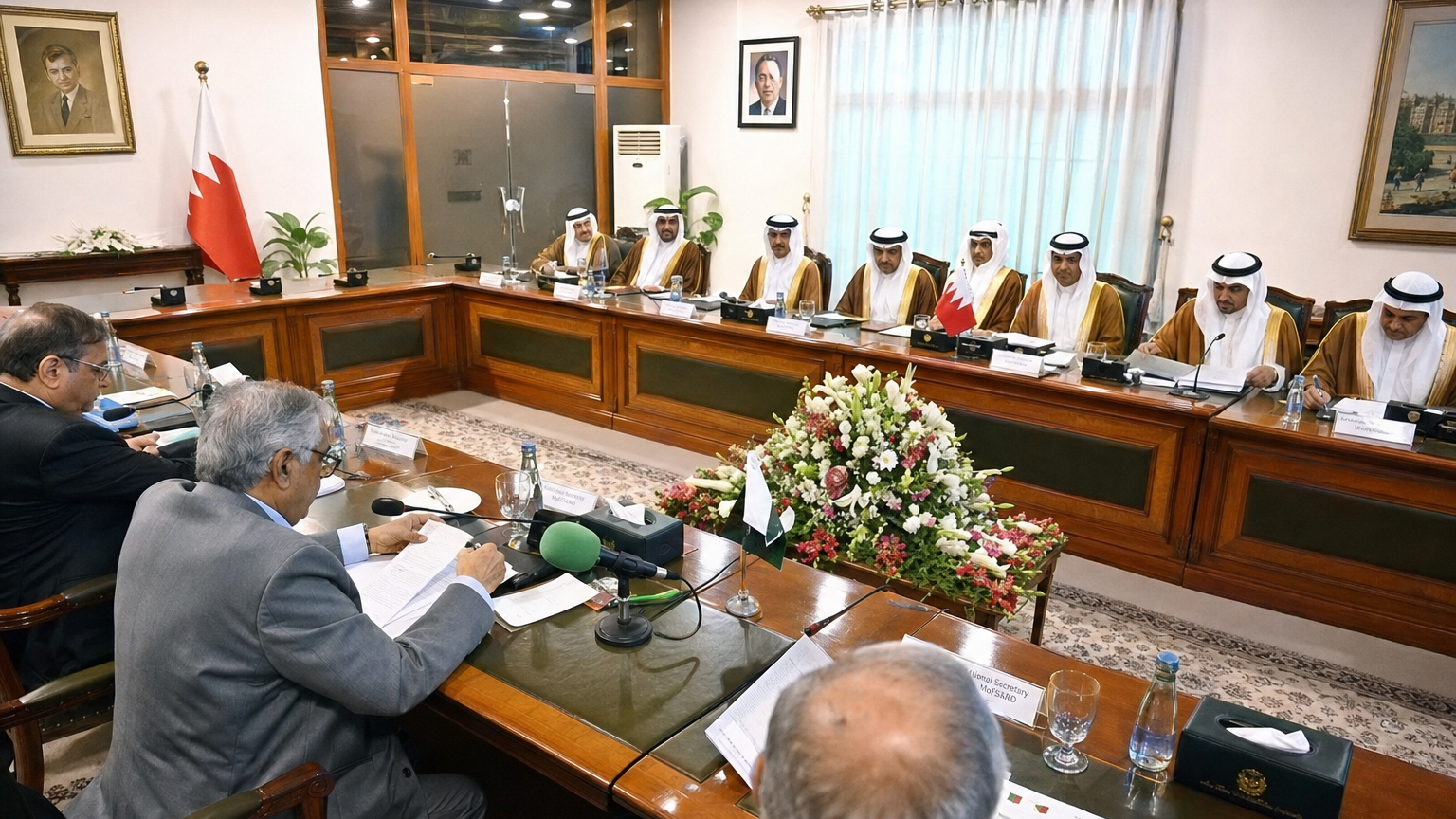

The third session of the Pakistan-Bahrain Joint Ministerial Commission ended with commitments to expand economic ties across more than 15 fields, co-chaired by Deputy Prime Minister and Foreign Minister Ishaq Dar and Bahrain’s Foreign Minister Dr Abdullatif bin Rashid Al Zayani. The two sides signed a protocol that places trade and investment promotion at the centre of their agenda, with both ministers stressing the need for closer government-to-government and business-to-business engagement to deliver results. Dar described the talks as comprehensive and productive, noting that the institutional framework would be strengthened through regular meetings of the newly agreed groups.
Bahrain’s top diplomat told the joint press conference that the countries would establish a working group on trade and investment while scheduling an energy group meeting next month to cover oil, gas and minerals. Al Zayani added that Manama would use its current presidency of the Gulf Cooperation Council to accelerate final approval of the long-pending Pakistan-GCC Free Trade Agreement, whose main negotiations concluded in 2023. The two sides also reaffirmed their aim to double bilateral trade within three years, building on momentum from earlier discussions that had set the same target when volumes stood at roughly $550 million.
Cooperation will extend to agriculture, food security, information technology, industrial collaboration, skills development, higher education, logistics and maritime affairs, according to the agreed minutes released after the session. The ministers welcomed stronger direct links between business communities and committed to advancing labour mobility, health, education, culture and sports exchanges. A Business Recorder assessment of the GCC-Pakistan trade relationship placed Pakistan’s overall merchandise trade with the six Gulf economies at $20.2 billion in 2024, with Pakistani exports accounting for only about $3 billion of that total.
Dar highlighted the contribution of the Pakistani community in Bahrain, where approximately 134,000 nationals currently reside, and called for expanded opportunities for skilled workers as part of the labour mobility track. The Pakistani side expressed satisfaction with Bahrain’s support at multilateral forums and proposed further facilitation of manpower movement to match demand in the kingdom. Officials from both governments agreed that vocational training and institutional partnerships would help align workforce skills with emerging opportunities in the agreed sectors.
Regional developments formed a significant part of the discussions, with the ministers exchanging views on Afghanistan, the Indus Waters Treaty and the situation in the Gulf. Both sides emphasised the importance of dialogue, de-escalation and diplomacy to reduce tensions while underscoring the need for safe shipping through the Strait of Hormuz and Bab al-Mandab. Al Zayani appreciated Pakistan’s role in hosting recent talks aimed at regional de-escalation and praised its principled positions on related international issues.
The meeting took place as Pakistan and Bahrain prepare to mark 55 years of diplomatic relations on October 14, with both ministers describing ties as strong, healthy and forward-looking. They agreed to hold the fourth session of the Joint Ministerial Commission in Bahrain next year to review progress on all tracks, including implementation of the decisions taken in Islamabad. The Foreign Office stated that follow-up through the joint working groups would ensure sustained momentum on the economic and strategic partnership.